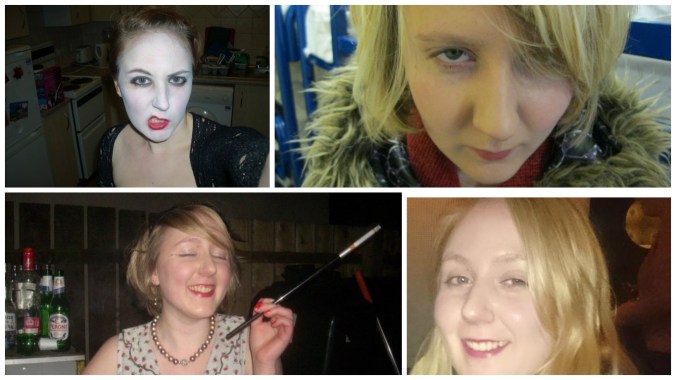
I felt that it was necessary to say, before I delve further in to the discussion surrounding beauty standards, that I am not criticising women for trying to look beautiful. We all fall prey to it, male and female, and I am not exempt from this. As you can see from the pictures above, I have been known to wear makeup, not always in the most conventional of ways, and not always much, but it is makeup none the less. And don’t I look a helluva lot better when I’m wearing it? Of course I do. As I mentioned in my previous post, a lot of the reason that I don’t take good selfies is because I simply can’t. The same applies to wearing makeup. I was never very good at applying it, and so part of the reason that I often don’t or at least don’t wear much is because what on other girls looks hot, on me does not. Half the time I attempt something daring in the makeup department before a night out, I end up looking like a child has scrawled crayon on my face, and I have to wash it off and start again. My not wearing much makeup does however have more reasons behind it than this.
From an early age, I have been self-conscious about the way I look. What began as teasing in school over what I realise now was only slightly bad skin (at the time I convinced myself I was the Elephant Man reincarnate and that nobody would ever love me, thanks puberty!) turned into a very deep self-consciousness and hatred of my own face. Due to this paranoia, I didn’t wear any makeup throughout my school career, apart from the odd slash of black eyeliner (to show how alternative I was). I felt that wearing makeup would only highlight my desire to hide my flaws, and therefore draw more attention to them. I felt if I wore my flaws for all to see that I would trick people into thinking that I didn’t care about them, and that I in fact liked myself.
Yet another reason I did this was because even at a young age I was aware that it was unfair to criticise and judge someone for how they looked, and this kind of behaviour was rife at my school (and every school, I imagine). A pretty, popular girl who didn’t like me chastised me one day in first year for hanging out with another girl. I didn’t understand the issue and when I questioned her as to why I shouldn’t be friends with this girl the popular girl replied conspiratorially, ‘because she’s fat’. It shocked me that although this girl did not like me, she still felt that I was ‘too good’ to be friends with a fat girl because I was thin. So thin and ugly is still better than fat? Who made these rules? And so I was introduced to the hierarchy of beauty that I have been painfully aware of ever since.
It was in fact a small act of rebellion on my part to not wear makeup or conform to the beauty standards that my class-mates had somehow acquired through osmosis (or maybe I was off sick the day they covered ‘How to Demoralise Your Peers for Your Own Self-Elevation 101’). This silent rebellion continued to cause me trouble throughout my days at school, and led to me being called all sorts of things from frigid to freak, ugly to lesbian (to name a few). And if a boy dared to speak to me, he was mercilessly teased for liking ‘the freak’. It really annoyed people that I didn’t conform. I learned this from a very early age. What began as naivety and self-consciousness on my part, became a battle against conformity.
And so began my battle with beauty standards and what they meant to me. Because as much as I wanted to be myself and love myself for who I was, I didn’t. I may have been aware that the attitudes of my peers were shallow and cruel, and I did not agree with them one bit, but another part of me secretly longed to be beautiful, or at least pretty. Because who wouldn’t, in a world where so much importance is placed upon it, especially for women? Again, from an early age I learned that if you don’t conform, and if you are not deemed ‘pretty’, you will most likely get a hard time, or get ignored altogether. Other qualities just don’t hold the same power. I was one of the smartest girls in my year, which should have been a good thing, and was in ways, but socially it only caused me more problems. It angered people that I was smart and that I refused to be pretty. Because often people do not want to hear from ugly, smart women. Sorry, but it’s true. Women can be smart, but they are expected to fit into the other social norms.
I’m reminded of an article I read about Hilary Clinton a few years ago, where she gave a speech somewhere and appeared to not be wearing any makeup. This damn near broke the internet. And since then there have been many articles surrounding this very issue, with every possible opinion being expressed, from people berating her as a hag to headlines congratulating her on her brave and bold move. Now don’t get me wrong, I am no fan of Hilary Clinton’s politics. And as a person, well, I don’t know her, she’s a politician. But the internet sensation surrounding the fact that she wore no makeup was frankly shocking. Whether she was being berated or celebrated, I found it all ridiculous. It should be a non-issue in the political arena, and yet it is focused on again and again. And it was just another example in many of what I already knew to be true, that a woman cannot just be smart, that is not enough. And if she is, and she refuses to conform to typical beauty standards, she must be prepared for an onslaught of abuse.
You could say that the internet is the schoolyard of the world, where every single thing you do can and will be held against you, re-tweeted, trolled. I rather grimly saw my school experience as a microcosm of the wider world, with its hierarchies, rules and regulations that I often could not, or would not, follow or understand. Now, over ten years on, I don’t think I was wrong in thinking that. And I feel that the internet is another example of a microcosm. Like the world, the internet has many beautiful things, and one way in which it has helped me immensely is when I read other peoples experiences in their blogs, and feel inspired. And it has given me this outlet, which hitherto I did not have.
However, as with the world, there is a nasty side. And the danger with the internet, and with the media in general, is that not only can it be nasty, but it is also not real. It is a representation of reality. And this is where it can be very damaging, especially to young, susceptible girls. I can not express how thankful I am that social media and selfies were not established as the norm when I was in school. What I went through on a day-to-day basis was enough, if I had spent hours every night staring at perfect celebrities, class-mates perfect selfies (I’d be stalking them because they wouldn’t have friended me) and pictures of them all having a social life which I was not privy to, I think my issues would be a lot worse.
And this is why I feel that although we all have a right to want to feel beautiful, we must be careful with how much emphasis and meaning we place on physical beauty, and by what criteria we judge ourselves and others. I worry that we are increasingly living in a kind of hyperreality where distinctions are being lost and expectations are too high. Something’s gotta give. And while addressing this massive issue in a blog originally about makeup is not going to change the world, for me, it’s a start.
 takingbackmyface